
The artistic interventions by members of the Neue Münchner Künstlergenossenschaft could be encountered throughout the permanent exhibition on the ground floor. They extended the museum’s existing collection, spanning the periods from Gothic to Art Nouveau, by introducing a discourse that reaches into the present. Some works were created specifically for this project, while others were newly conceived for the occasion.
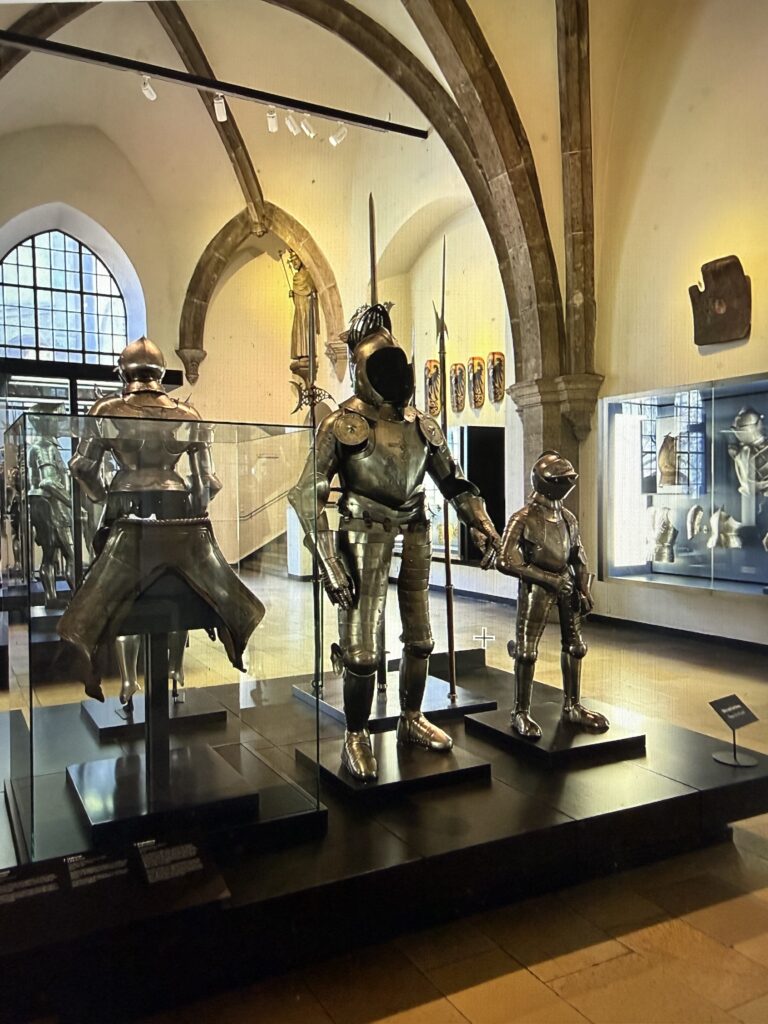
For my contribution, I chose the Armoury Hall (Room 18, Rüstungssaal). Armour does not speak only of war and combat. It also reveals technological developments, craftsmanship and the competition for strength and superiority.
Initially, it was the peculiar silence of this room that attracted me. The suits of armour stand close together in separate groups, without touching, arranged along four viewing axes. Their predominantly vertical structures support their own weight, maintaining an upright, almost human presence. Each suit presents a distinct front, as if the invisible interior – the body it once enclosed – were still protected behind its elaborately crafted metal layers.
This silent arrangement almost made me want to listen to it. If these static forms were suddenly set in motion, there would be more than the clashing of metal parts, the creaking of joints and the sound of heavy bodies moving – sounds familiar from films or historical reenactments of medieval tournaments. They belong to a particular notion of combat and danger. But the dangers of our time sound different. Today, threats often announce themselves through technical signals, warning alerts or a barely perceptible hum.
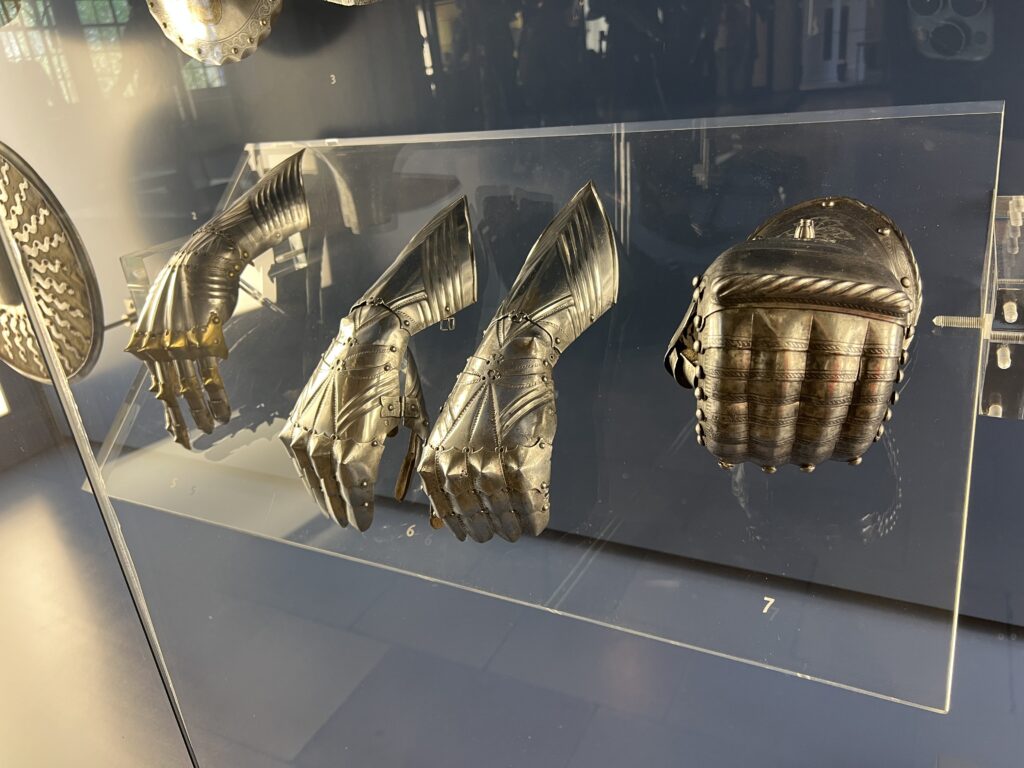
I am drawn to the gestures and forms of hand protection, both historical and contemporary. Every hand in this hall seems designed to wield a weapon or hold a shield. The perfection of the ergonomic mechanisms developed for each wrist immediately reminds me of modern motorcycle gloves. Other weapons and hand-protecting elements are displayed parallel to one another on the museum walls. Some display cases contain a pair of these protective pieces, while most present individual items.
Today, we surround ourselves with protection in many different ways: in our homes and cars, during sports and leisure activities. We protect ourselves from sun and cold and use specially designed equipment to prevent or reduce injuries – from bicycle and ski helmets to back protectors. For many situations, there is a corresponding protective layer, a technical or material extension of our bodies. Yet this protection remains at the surface. We can protect ourselves externally, ward off dangers and limit physical injuries. Within ourselves, however, we remain vulnerable. Our inner vulnerability cannot be equipped with the same degree of protection. Between what we can protect and what remains unprotected, a fundamental tension emerges.
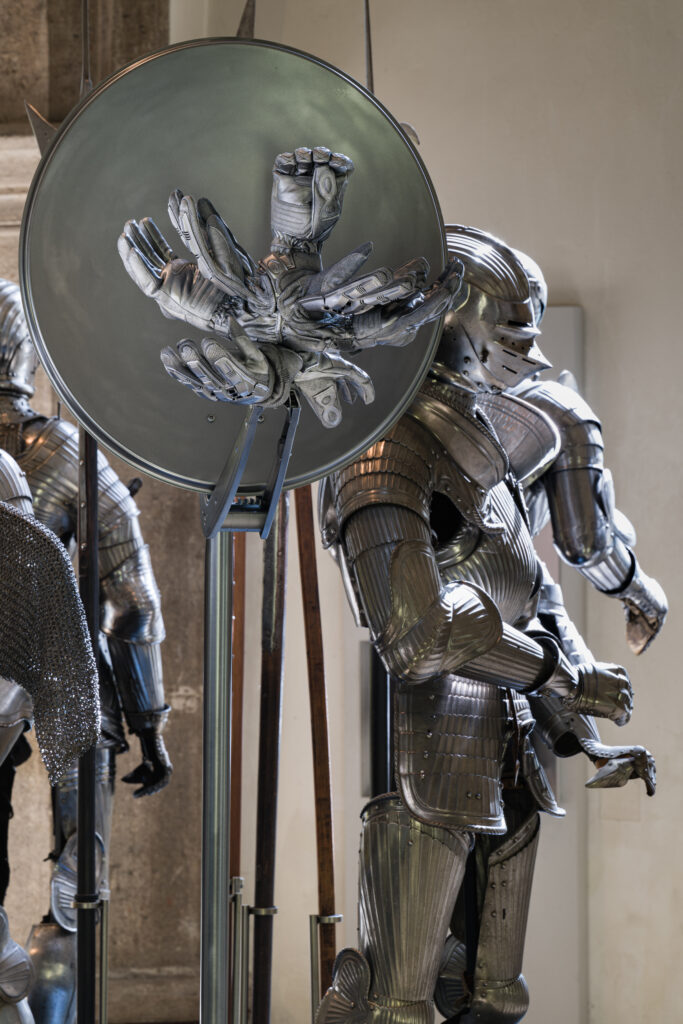
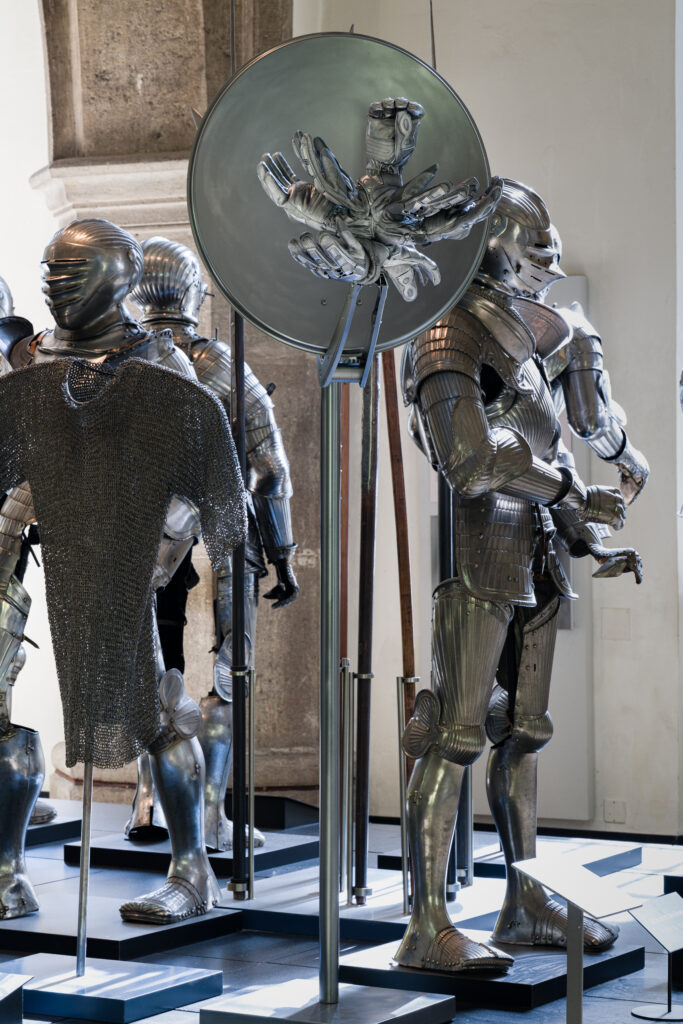
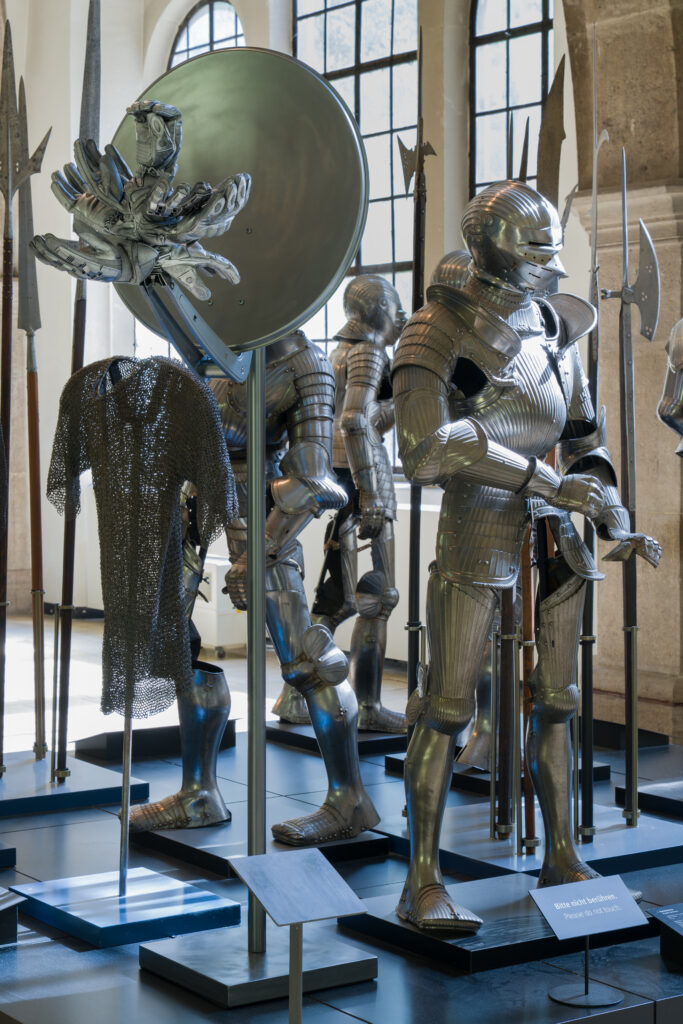
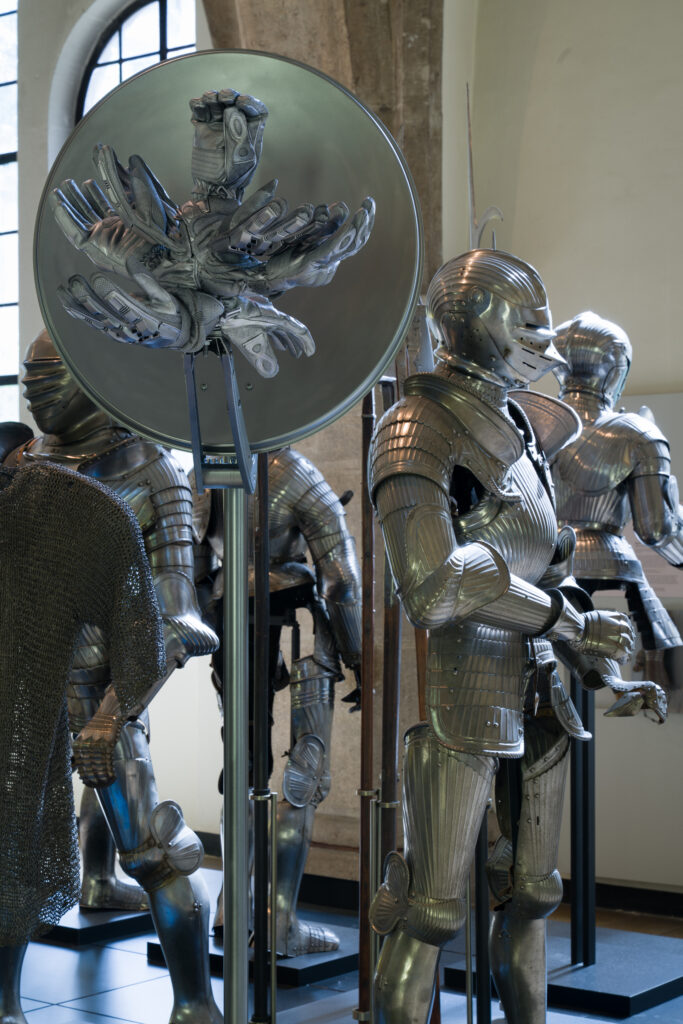
These reflections became the starting point for my work Handstück: a connection between a historical protective construction and a contemporary everyday object, between technical sophistication and physical vulnerability.
Embedded within the group of suits of armour, the sculpture almost blended in so well that it could easily escape the viewer’s attention. It did not reveal itself through a sound, but rather through its silver-painted surface, which stood out against the patina of the historical armour. A silver layer of paint formed a glossy shell around the soft material inside the gloves.
The motorcycle gloves formed a unified sculpture composed of seven individual pieces. One glove remains without its counterpart. Perhaps this also recalls an everyday experience: not only children’s gloves are often lost, left behind somewhere along the way, while travelling or on the move. Motorcycle gloves are, in fact, also available in children’s sizes. This realisation made me reconsider the relationship between protection and risk from a different perspective.
Despite its visual resemblance to the historical objects, the sculpture introduced a question into the space: What has changed over the centuries – and what has actually remained the same?
For more detailed information about the group exhibition, visit:
https://www.bayerisches-nationalmuseum.de/besuch/ausstellungen/kuckuckseier