
UMFELD A – 174
Participation in a group project in the historic city center of Aichach during the pandemic.
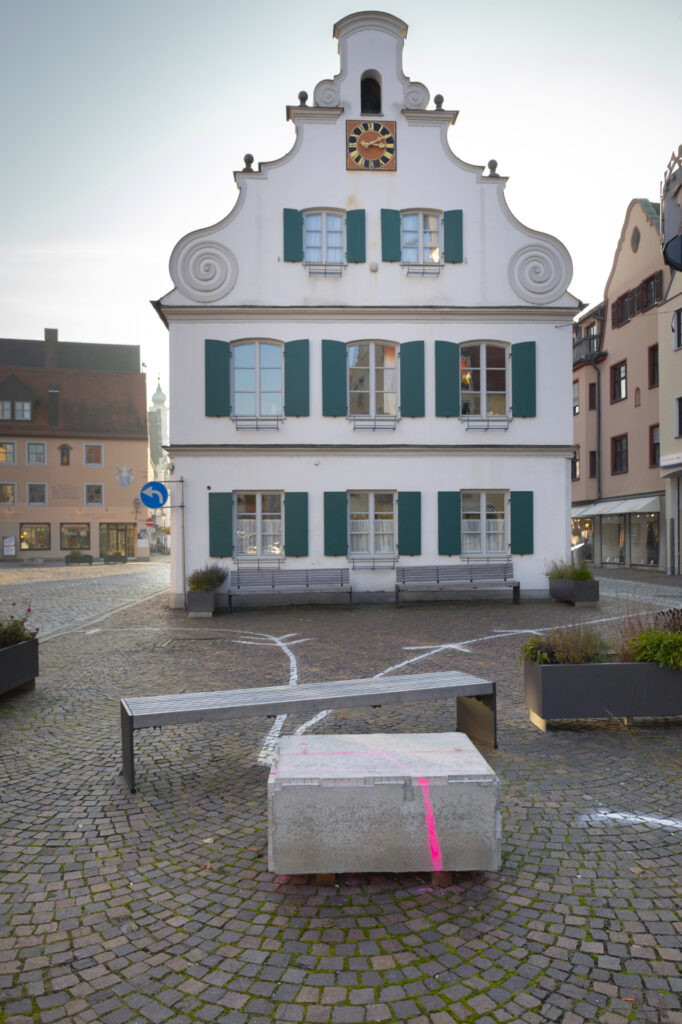
Artists were invited to create works that were temporarily installed at specific public sites in the old town and could subsequently be reworked and altered by two other participating artists. Over the course of one summer, the city’s residents were thus given insight into a playful, collegial process of transformation and became part of the game.
Cast in a local concrete plant, the production process sparked an exchange on the aesthetics and functionality of concrete, a material central to my practice.
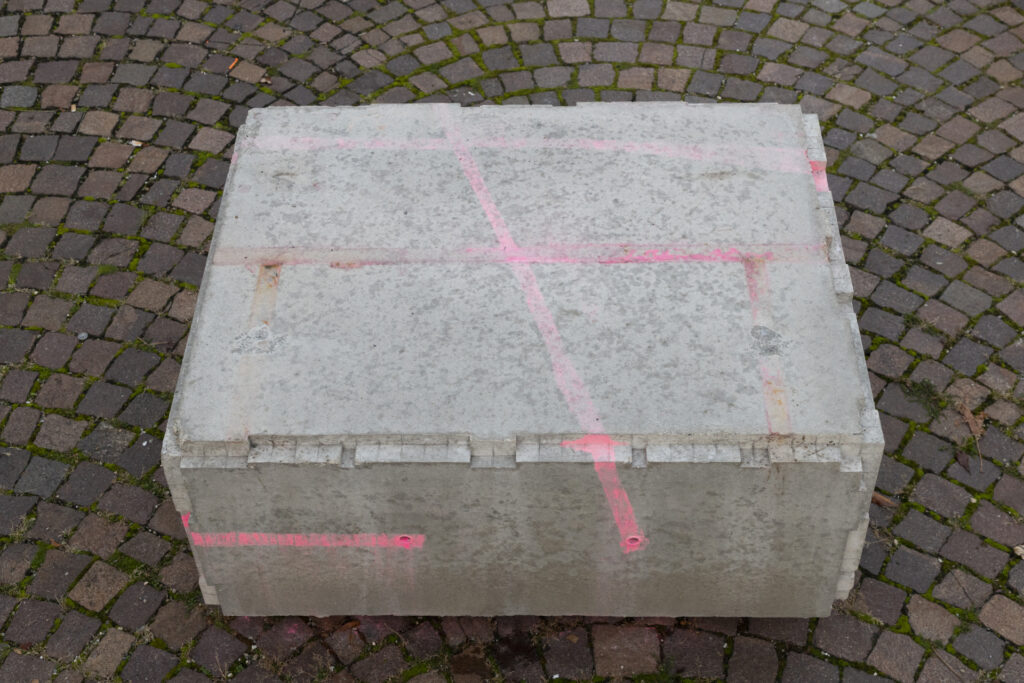
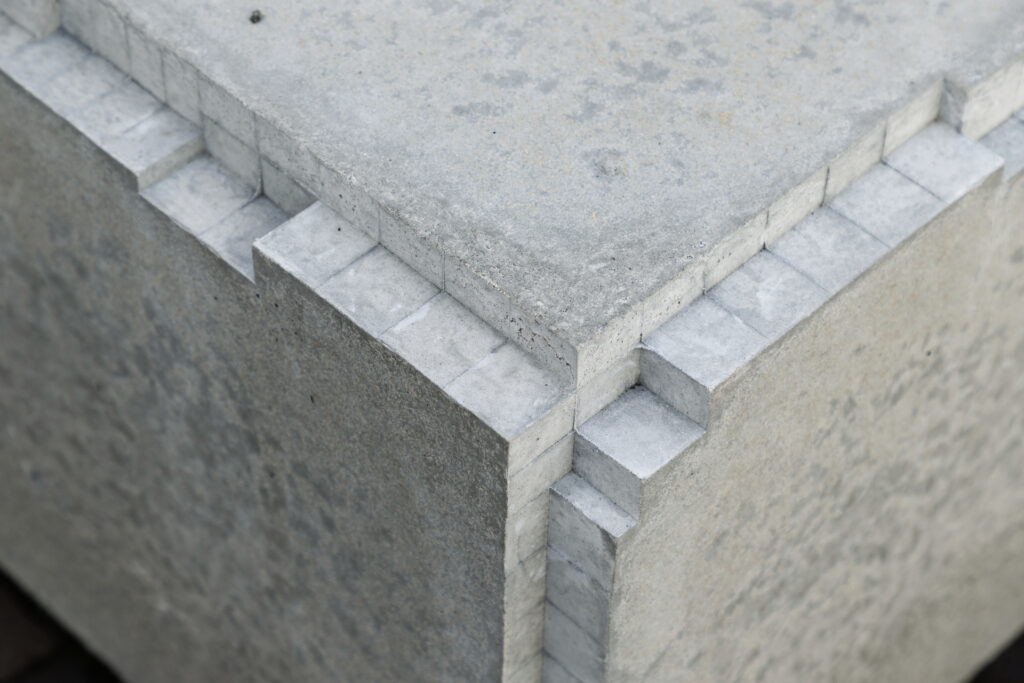
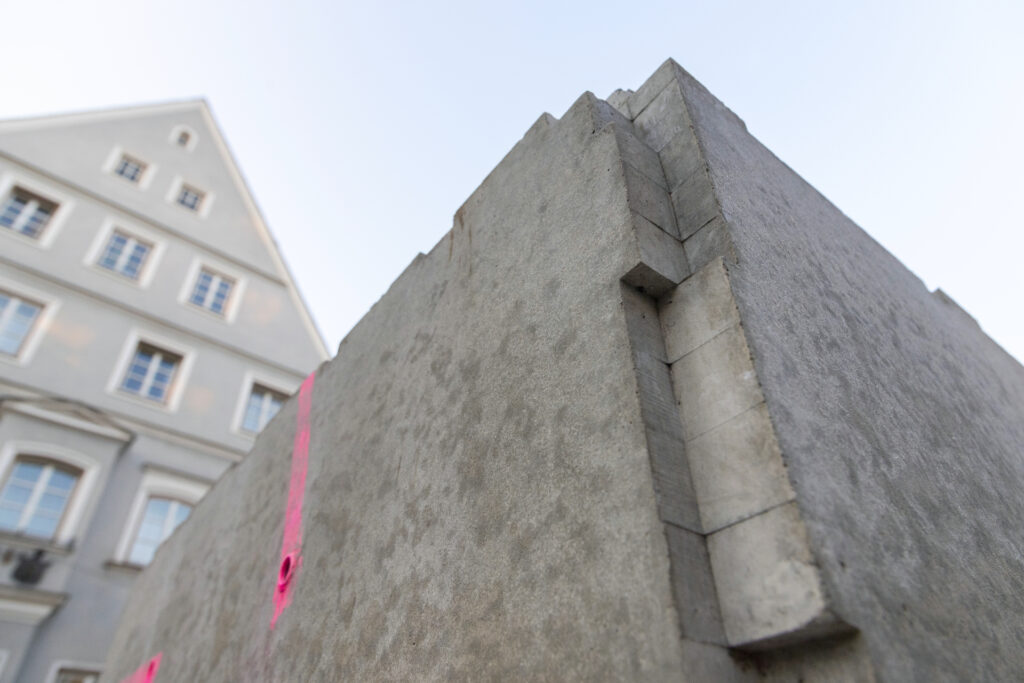
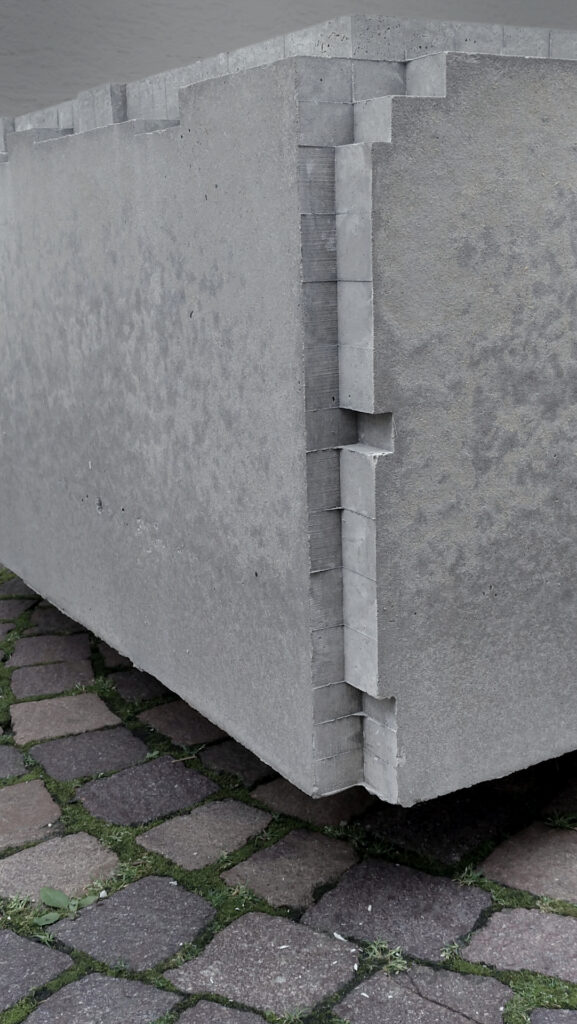
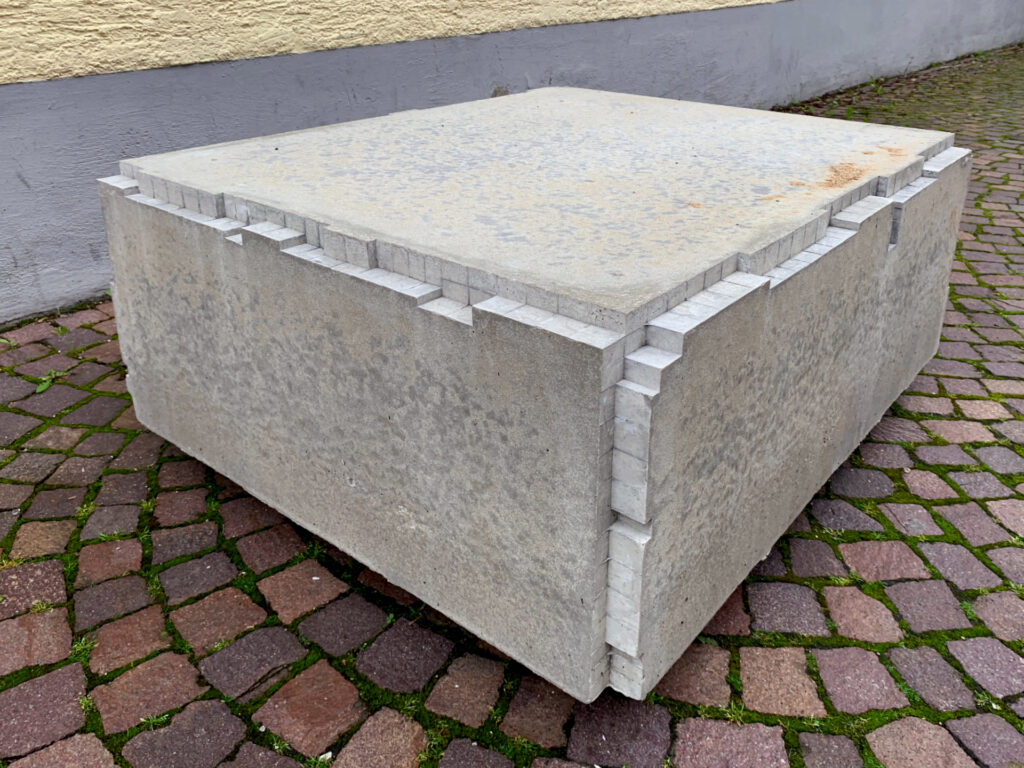
Cast like an apparently ordinary cuboid – rough and simple at first glance – the object retained a fragile outer edge composed of variations of small, missing (recessed) cube chains running along all surfaces. As a result, loading and unloading during transport became a topic of discussion among the employees of the concrete plant, who detected a hidden joke in the object while also reflecting on the vulnerability of concrete edges based on their professional experience.
The cast concrete object appeared at two locations within the city and was positioned in such a way that no clear classification as a pedestal, seating object, or road barrier was possible. The heavy object thus remained in a state of suspension. It questioned the street space itself; the architectural and urban-planning silhouettes along its surfaces could be read up close like a form of Braille.
The next artists, Ergül Cengiz & Moritz Altmann, continued the work in this format, using the cube as a pedestal for a metal window sculpture referencing window grilles, which later seamlessly became a surface for a sprayed drawing by Esther Irina Pschibul. In this way, the object accumulated further urban traces and continued its transformation within the city.
Although concrete and the urban environment are commonly perceived as static, immobile, and anchoring, the three-step artistic transformation enabled a shift in perception. The successive interventions introduced functionally ambiguous traces rather than decorative additions, increasingly undermining the object’s legibility. In this process, architectural narratives emerged – individual and situational – unfolding as temporary propositions within the urban space.
DE
Teilnahme an einem Gruppenprojekt in der Altstadt von Aichach während der Pandemie.
Künstler:innen wurden eingeladen, Werke zu schaffen, die temporär an bestimmten öffentlichen Plätzen der Altstadt ausgestellt und anschließend von zwei weiteren Künstlerkolleg:innen überarbeitet und verändert werden konnten. Somit erhielten die Stadtbewohner:innen innerhalb eines Sommers Einblicke in eine spielerische und kollegial konternde Transformation und wurden Teil des Spiels.
Mein Werk wurde in einem lokalen Betonwerk gegossen und war bereits während des Produktionsprozesses Ausgangspunkt eines regen Austauschs über die Ästhetik und Funktion des Werkstoffs Beton, der seit mehreren Jahren einen wichtigen Platz in meinem Werk einnimmt.
Gegossen wie ein auf den ersten Blick gewöhnlicher Quader, behielt der Guss eine fragile Außenkante, die aus Variationen kleiner, fehlender (ausgesparter) Würfelketten bestand und entlang aller Flächen verlief. Dadurch wurde das Be- und Entladen während des Transports bereits zu einem Thema für die Mitarbeiter:innen des Betonwerks, da sie darin einen versteckten Witz aufspürten und zugleich die Problematik von Betonkanten aus ihrer eigenen Erfahrung thematisierten.
Das gegossene Betonobjekt tauchte an zwei Orten der Stadt auf und wurde so platziert, dass keine eindeutige Einordnung zwischen Sockel, Sitzobjekt oder Straßensperrung möglich war. Das schwere Objekt befand sich somit in der Schwebe. Es stellte den Straßenraum an sich in Frage; die architektonischen und städteplanerischen Silhouetten entlang seiner Flächen wurden aus der Nähe wie eine Blindenschrift lesbar.
Die nächsten Künstler, Ergül Cengiz & Moritz Altmann, setzten das Werk in diesem Format fort, indem sie den Würfel als Sockel für eine Metallfensterskulptur nutzten, die Fenstergitter zitierte, und die nahtlos später in eine Fläche für eine gesprayte Drahtskulptur als Zeichnung von Esther Irina Pschibul überging.
Obwohl Beton wie auch der Stadtraum gemeinhin als statisch, unbeweglich und verankernd gelten, wurde innerhalb der dreistufigen künstlerischen Transformation eine Verschiebung der Wahrnehmung möglich. Die fortlaufenden Eingriffe erzeugten keine dekorativen Spuren, sondern funktional missverständliche Überlagerungen, die die Lesbarkeit des Objekts zunehmend unterliefen. Auf diese Weise traten prozessual und individuell architektonische Erzählungen hervor – weniger als festgeschriebene Formen, sondern als situative, temporäre Bedeutungsangebote im urbanen Raum.