
JŪS ESATE ČIA
This installation is part of the solo exhibition NO LAND, NO EARTH, NO SOIL, NO GROUND by Patricija Gilytė, site-specifically developed for the four museum spaces of the Kasiulis Art Museum, Vilnius, Lithuania.
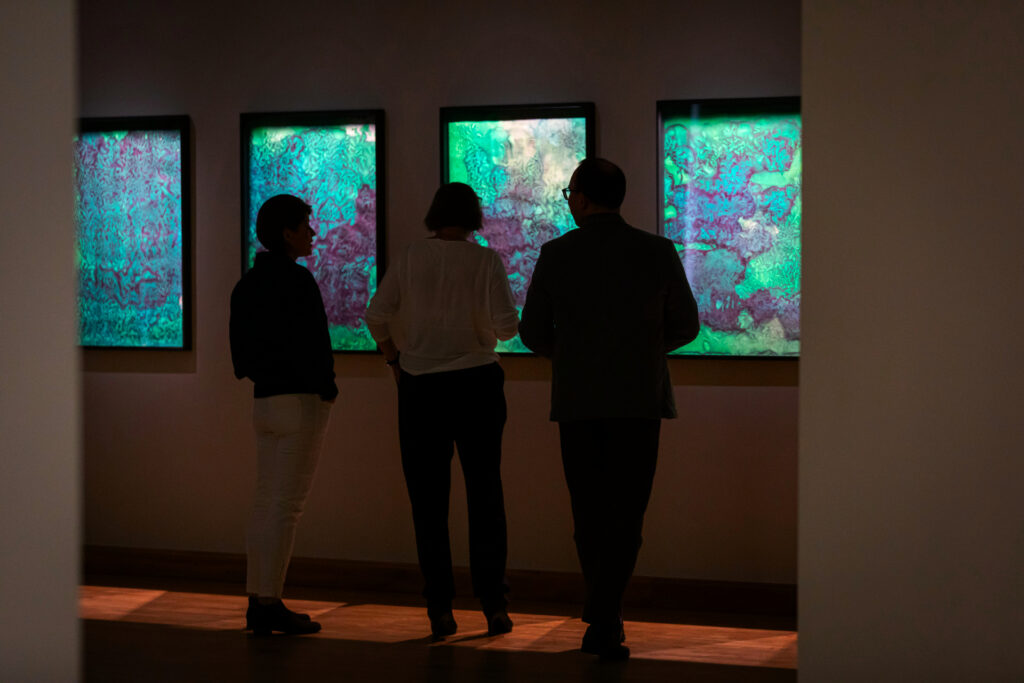
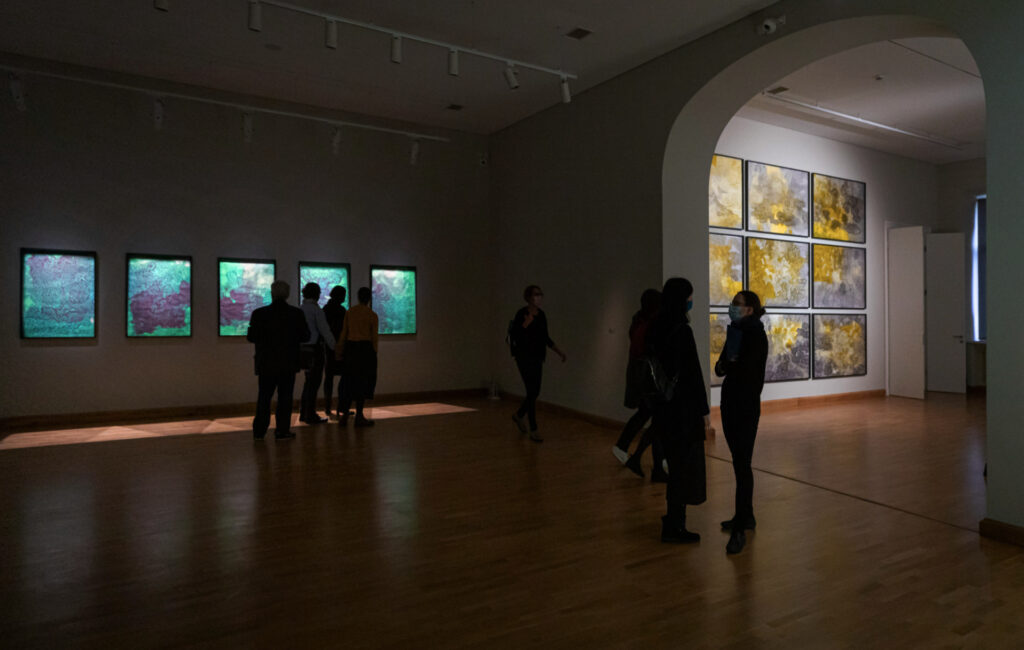
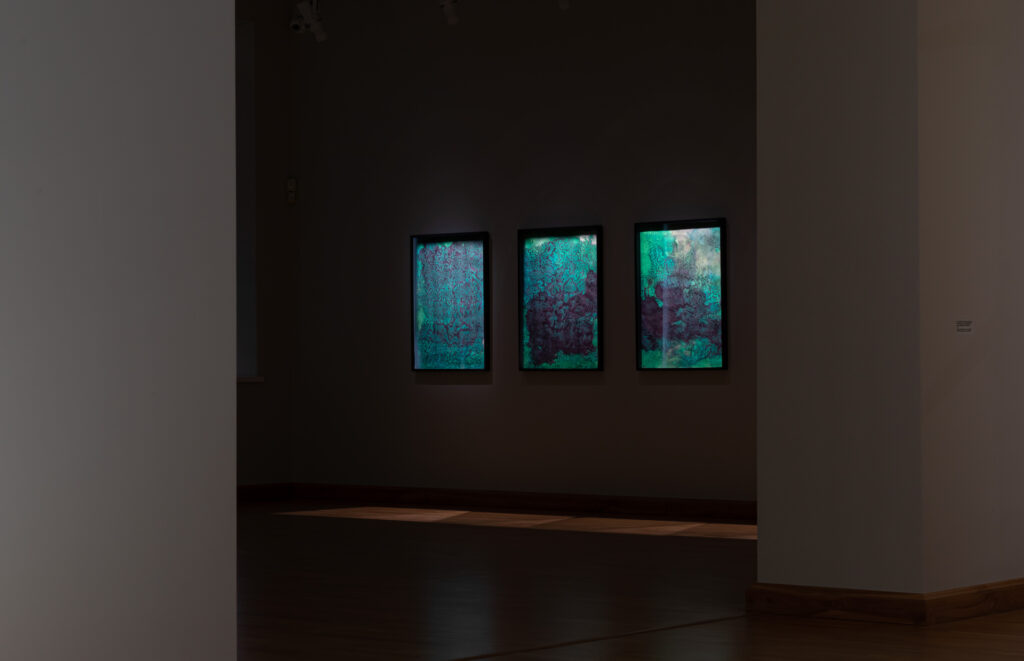
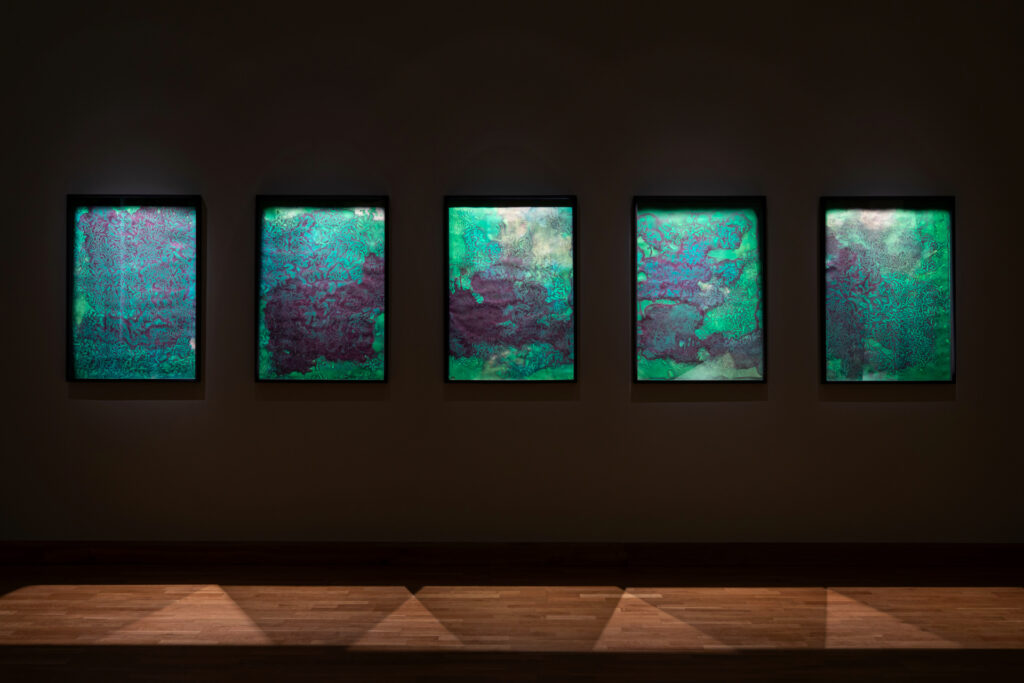
After passing through the first darkened, scent-filled room, dominated by a central battlefield relief of a fir-needle–covered plain (BATTLEFIELD OF GRUNWALD), the visitor enters a second space. On the wall directly opposite the entrance, illuminated, window-like drawings are presented. Positioned symmetrically and framed in dark wooden frames, the works invite the gaze to glide across surfaces. Intensified shades and intricate patterns unfold according to the viewer’s position, suggesting an inner cartography rather than fixed territorial borders.
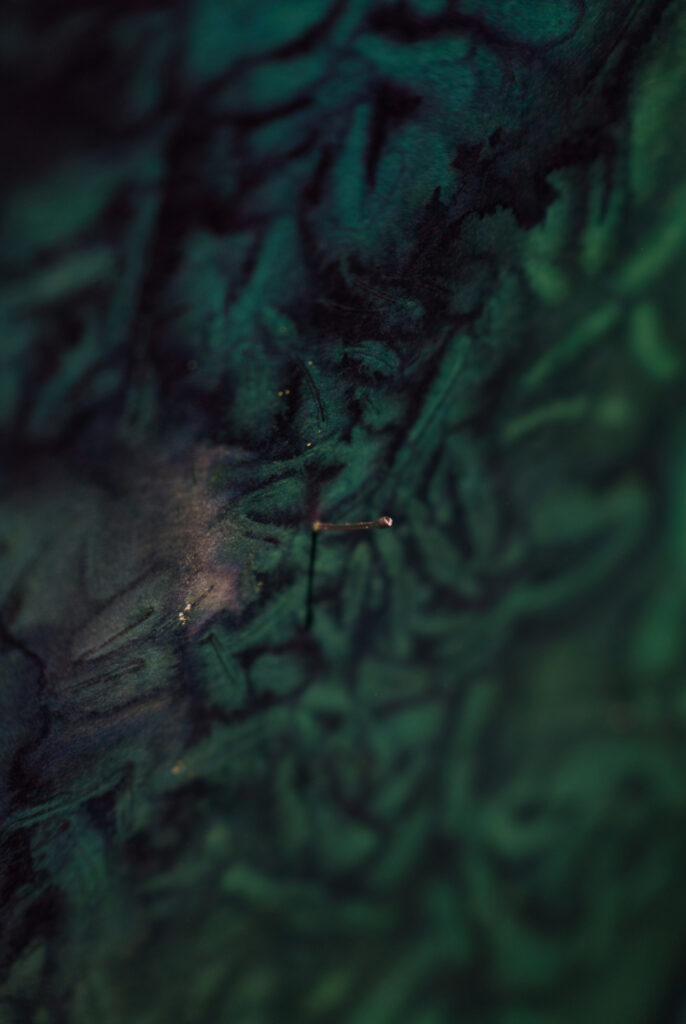
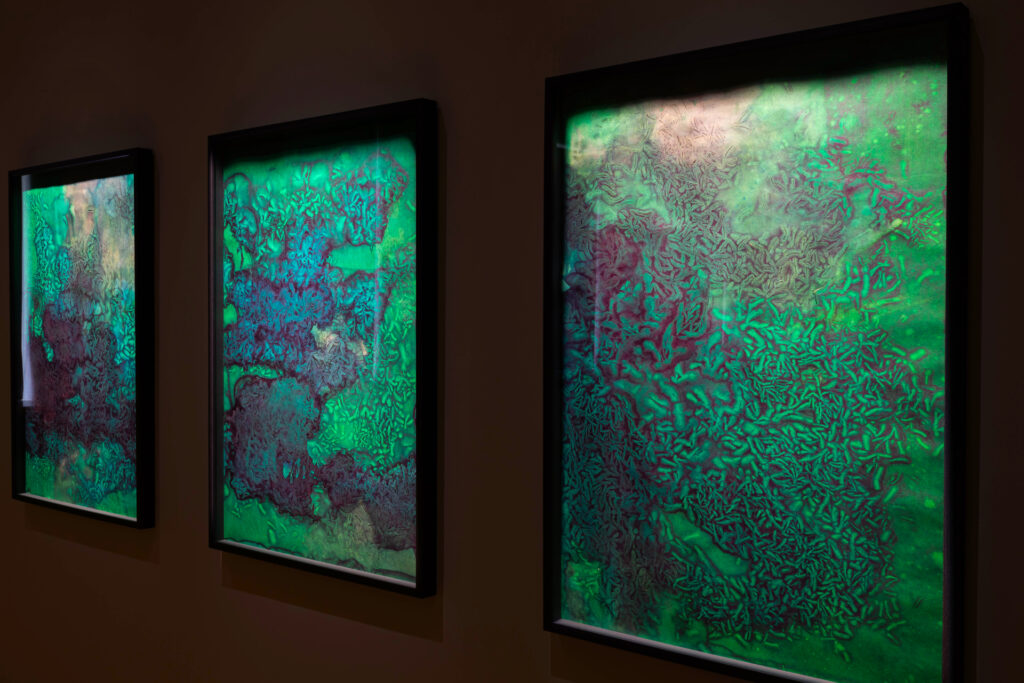
Ink drawings from the Conifers_Series are created using spruce needles, which cover the paper in successive layers. Ink is poured over the surface to produce a watercolor-like effect. The needles leave distinct traces, generating dense, intricate textures reminiscent of aerial photographs of forested terrain.
The resulting landscapes possess neither fixed edge nor horizon; they invite the gaze to wander through depths of dark green, emerald, and blue tonalities. At the same time, the viewer is offered a subtle point of orientation: a spruce needle cast in gold, marking an imagined position within this cartographic expanse.
Press release
EN//
Patricija Gilytė is a Lithuanian artist living and working in Germany, who graduated from the Munich Academy of Fine Arts with a degree in sculpture and works in the field of interdisciplinary art.
Her solo exhibition at the Vytautas Kasiulis Museum NO LAND /NO EARTH /NO SOIL /NO GROUND is an immersive exposition, which presents both early video works, the latest installations and geodata based animations, created especially for the museum spaces.
The works are built upon a foundation of Lithuanian cultural heritage, reimagined through visual means and relayed through media. Patricija Gilyte‘s works transform poetry into sculpture while preserving the local poetic “Lithuanian” associations (sand dunes, nuanced green colours: “…and lie face-down in moss”, to quote a poem by Dalia Saukaitytė, popularised by singer-songwriter Vytautas Kernagis) as well as global themes like migration and motifs dictated by climate change (e.g. the migrating forest series, which, over more than a decade, has turned into a series of spruce needle landscapes).
For the first time in Lithuania, the author presents drawings – monochrome maps created with ink and spruce needles. The museum is an empty space for her, open to all directions, which she captures with her artworks and attracts the viewer, encouraging her/him to immerse themself in geographical explorations of the historic Battle of Grunwald, which eventually turns into layers of green forest and green connotations. The only way out is to find the gold cast spruce needle (work series You Are Here, 2021).
(BATTLE-) FIELD OF GRUNWALD. 2021
In Gilytė‘s works, local, national themes intersect with the global. In Lithuanian, the word žemė can refer to either the planet Earth, or land, as in a field or territory, as well as soil as a formative element of our identity these notions emerge in Gilytė‘s works taking multiple forms, evoking various associations. For her, land is much like an archetypal field that localises through artworks. It exists in our imaginations and reflections, in historic memory and literature, it is recorded in maps and ownership documents, and it is the recurring motif of this exhibition. Earlier video works are being weaved into a new fabric with installations and video projections created in situ for the museum space, along with monochrome maps drawn using ink and spruce needles, never before shown in Lithuania.
Text by Dr. Jurgita Ludavičienė, curator of the exhibition
Lithuanian National Museum of Art
Exhibition views: Patricija Gilyte NO LAND /NO EARTH /NO SOIL /NO GROUND, 2021
Lithuanian National Museum of Art / Kasiulis Museum of Art, Vilnius, Lithuania. Photos by Gintarė Grigėnaitė